
Chronology
The story of Galileo's works
after 1642

Many
of Galileo's works were published during his lifetime, while others came out
posthumously.
The
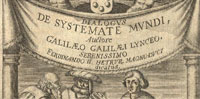
Dialogo sui massimi sistemi del mondo
[Dialogue on the Great World Systems]
(Florence, 1632) and the Letter to
Christina of Lorraine were translated into Latin by Matthias Bernegger,
while the scientist was still alive.
Some
of Galileo's writings used for teaching at Padua were printed many years later.
Le Mecaniche [The Mechanics] was
published by Luca Danesi, but had already circulated, in the French translation
by Marin Mersenne of 1634. The Trattato
della Sfera [Treatise on the Sphere] was published in Rome by Urbano Daviso.
The
first edition of the Galileo's Works, published in Bologna by Carlo Manolessi in 1656,
did not include the Copernican Letters
nor the Dialogue, which was secretly
reprinted in 1710, and in Padua in 1744 with authorization to print. The Dialogue was removed from the Index of
prohibited books only in 1835.
The
National Library of Florence conserves the Collection of Galilean Manuscripts,
which includes almost all of the autograph heritage of the Pisan scientist,
along with the manuscripts of his disciples Benedetto Castelli, Bonaventura
Cavalieri, Evangelista Torricelli and Vincenzo Viviani.
The
National Edition of the Galileo's Works
edited by Antonio Favaro in 20 volumes contains Galileo's entire literary
production and constitutes the chief reference point for studies on the Pisan
scientist.